
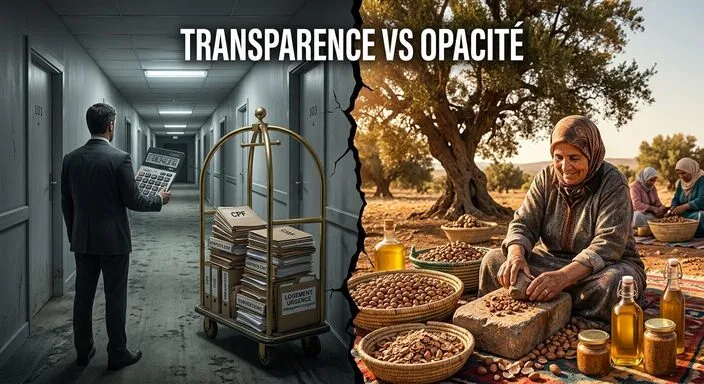
Transparency vs Opacity: What Is Truly Fair Trade?
The word “ethical” has become a marketing argument. Companies, institutions, and political speeches all claim it. Yet, as soon as you follow the money, two opposing logics emerge: on one side, real value creation—labor, expertise, raw materials, traceability; on the other, opaque mechanisms of rent extraction, where wealth is accumulated without producing exceptional goods or faultless services.
Quick answer: Truly fair trade is measured by three verifiable criteria: a traceable chain (where every euro goes), prioritized compensation for producers, and the informed consent of the buyer. It is not a label on a package: it is the exact opposite of guaranteed rents funded by taxes or “free” training paid for by mandatory contributions.
Key Takeaways
- Real value: A product or service that can be evaluated, traced, and paid for with full knowledge of the facts.
- Opaque rent: Public contracts with no real competition, intermediaries, and margins built on nothing.
- Illustrations: Emergency housing hotels in the UK and France; abuses of the French CPF training account system.
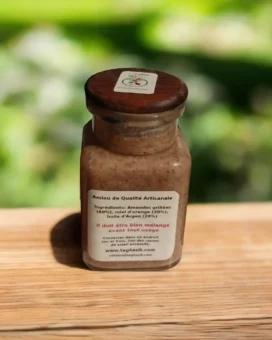
- Alternative: Short supply chains, named artisans, and prices justified by labor—such as artisanal amlou made by local women’s cooperatives.
| Criterion | Value Economy | Rent Economy |
|---|---|---|
| Source of profit | Product or service chosen by the customer | Public budget, emergency situations, “already paid” contributions |
| Commercial risk | Competition, high quality demands, possibility of losing the customer | Guaranteed occupancy, multi-year contracts, little questioning |
| Traceability | Materials, labor, shipping, margin: every euro has a recipient | Intermediaries, subcontracting, invoices hard to link to actual services |
| Final judge | The buyer, who can refuse | The taxpayer, who did not choose the expenditure |
We often contrast so-called “developed” democracies with so-called emerging countries, granting the former an automatic institutional virtue. European public reports show something else: billions can be contracted, legalized, and poorly monitored. Understanding these abuses helps define, in positive terms, what authentic trade is—one that compensates labor rather than opacity.
Emergency Housing: A Rent Guaranteed by Taxes
Housing people in distress is a legal and human obligation. The issue lies elsewhere. It resides in the economic model chosen when the state, failing to anticipate public placements, urgently subcontracts to the private sector—sometimes without real competition, sometimes without providers capable of matching the bill.
United Kingdom: Soaring Contracts
At the height of the crisis in 2023–2024, the Home Office spent roughly 8 million pounds per day housing asylum seekers in hotels—amounting to nearly 3 billion pounds for the year, according to the National Audit Office. Three major subcontractors (Serco, Mears Group, Clearsprings Ready Homes) handle these accommodation contracts. Their estimated budget of 4.5 billion pounds for 2019–2029 was revised to more than 15 billion over ten years. Investigations and audit reports documented dilapidated premises, reduced services, and higher profit margins on hotels compared to dispersed accommodation—a model where commercial risk vanishes: near-guaranteed occupancy, a single client (the state), and no need for marketing.
France: €3.2 Billion for Emergency Housing in 2023
The French Court of Auditors established that state funds allocated to housing (standard emergency housing and asylum seeker placements) reached €3.2 billion in 2023 for roughly 334,000 places. A portion of this capacity still relies on hotel nights and over-the-counter bookings. The same report highlights overly rare controls on certain managers and a reliance on hotels that, when it becomes structural, no longer offers the price or quality of a competitive market.
| Healthy Market | Observed Model (Emergency Hotels) |
|---|---|
| The customer compares and can leave | The state pays; the taxpayer has no daily oversight |
| Requires attraction and care in service | High occupancy rate, sometimes 100% of rooms |
| Price reflects service quality | High invoice for often minimal service (cleaning, food, maintenance) |
| Competition disciplines margins | Long contracts, little re-tendering, cascading subcontracting |
Why mention emergency housing in an article about trade?
Because it is a textbook case of extracted value without created value: public money circulates, private players rake in profits, and the service delivered to the recipient as well as the taxpayer is unsatisfactory. It is the exact opposite of an artisanal supply chain where the customer sees the product, knows its origin, and can decline to purchase.
The French CPF System: When Training Drains Public Funds
The French Personal Training Account (CPF) started with a noble intention: giving every worker a budget for self-improvement. By turning on the faucet without early safeguards, the system triggered a gold rush. Thousands of entities rebranded themselves overnight as “training organizations.” Cold calling (phone calls, SMS, social media) endlessly repeated an unbeatable pitch: “it’s free, the state pays,” when in reality, it is funded by workers’ contributions.
The outcome, documented by controls and successive reforms:
- Language courses reduced to a basic mobile app, without a real instructor.
- Skills assessments and coaching sessions lacking real qualifications.
- Ad hoc certifications without any recognition in the labor market.
A double waste: citizens lose time and their CPF balance, while the public loses hundreds of millions of euros. This is not education. It is a private profit built on empty promises—the same pattern as overpriced hotel rooms for degraded service.
Developed vs Emerging: A False Moral Superiority
In the collective imagination, the Western world embodies rigor and ethics, whereas Southern nations are seen as structurally “disorganized.” The cases above draw a different map:
- Legalized waste: Elsewhere, petty corruption is visible and named as such. Here, the diversion of resources is dressed up as “public-private partnerships,” “emergency management,” and subcontracting—contractualized, and therefore respectable.
- Bypassed consent: The taxpayer pays, but chooses neither the hotel, nor the training provider, nor the intermediary’s margin.
- Discouraged real economy: A system that enriches those who tick administrative boxes—rather than those who transform raw materials and expertise—devalues craftsmanship and tangible goods.
Traditional supply chains—Souss argan groves, olive orchards, beehives—have nothing to do with “backwards” folklore. They tie transactions to human effort, natural resources, and product utility. This is precisely what is highlighted in the journey of argan, from tree to table, or the cultural parallel in our article From Morocco to Japan: Trees Shaping Cultures.
Three Rules for Truly Fair Trade
An equitable model cannot simply be proclaimed in a charter. It must be verified.
| Rule | What It Requires | What It Excludes |
|---|---|---|
| 1. Supply chain traceability | Knowing what share goes to raw materials, labor, shipping, and distribution | Anonymous intermediary networks, vague labels, unnamed “vegetable oil” |
| 2. Fair producer compensation | Added value goes primarily to those who cultivate, press, and prepare | Margins captured by a broker or platform that never stepped foot in the workshop |
| 3. Buyer’s consent | Displayed prices, readable ingredients, named origins; the customer decides | False freeness, aggressive telemarketing, guilt-inducing promises |
In the food industry, opacity has a concrete face: diluted honey, “amlou-style” spreads without argan, and cheap oil bottles. Our guide on pure honey and amlou: recognizing artisanal quality (and scams) and our article on the secrets of pure, authentic argan oil detail the labeling reflexes to develop. Buying with confidence also means choosing the right vendor: see where to buy real Moroccan amlou.
The Taghazit Commitment: Transparency in Action
It is in direct response to these rent-seeking and opaque models that Taghazit conducts its business. We do not sell a concept. We offer the fruit of manual labor: cold-pressed argan oil and traditional amlou, rooted in the expertise of women’s cooperatives and artisans across southern Morocco.
- Direct link to the source: No opaque financial cascades. Freshness and purity are secured at the origin, and then during the preparation and dispatch of your orders.
- Fair compensation: Your purchase supports rural families who protect argan trees and pass down their craft—the complete opposite of making profit out of thin air.
- Tangible product: Three ingredients for amlou, one origin, one authentic taste. You can judge, compare, and decide whether to return. That is real consent—the exact element missing from public rents.
Promoting an artisanal product that remains discreet is also a refusal to let industrial volumes monopolize the space. We discuss this in From Shadow to Light: Revealing an Artisanal Product.
Frequently Asked Questions
- Is fair trade just about having a label? A label can help, but it is not enough. The key question is: who is named on the jar, where do the raw materials come from, and what share goes to the producer?
- Why does a gourmet food site discuss emergency housing and training funds? To demonstrate that opacity is not a defect exclusive to “Southern countries.” It exists in sophisticated forms within wealthy democracies. Food trade faces the same choice: short supply chains or opaque intermediaries.
- How can I verify the traceability of amlou? Look for three ingredients (nuts, culinary argan oil, honey), Moroccan origin, and an identified producer or cooperative. See also organic artisanal amlou.
- Is a higher price necessarily more ethical? No. The price must reflect real costs (rare argan, manual labor). A ridiculously low price is a red flag; a high price without a named origin is simply an inflated margin.
- What can I do concretely? Read labels, reject fake freeness, buy from businesses that document their supply chain, and if the taste and origin suit you, support a Moroccan fine grocery store rather than an anonymous commercial spread.
Truly fair trade doesn’t need self-righteous rhetoric. It needs a readable supply chain, a fairly compensated producer, and a free customer. Everything else—hotel rents, ghost training courses, vague labels—is opacity disguised in grand words.
A Concrete Example: Our Artisanal Amlou
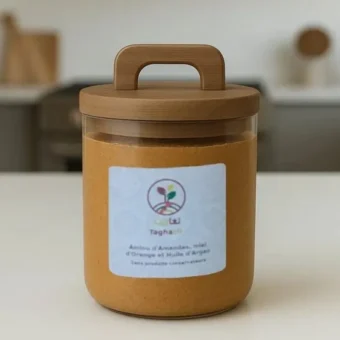
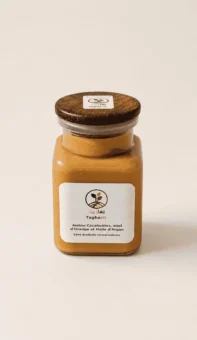
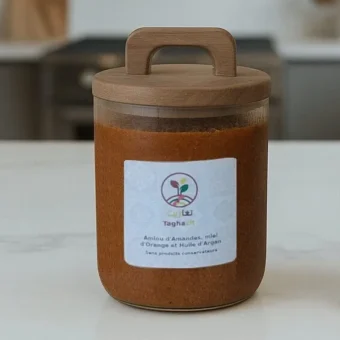
Three ingredients, Moroccan origin, artisanal craft: here are the products we offer, featured directly as they are in our shop, plain and simple.
Choose a Short and Named Supply Chain
Browse our selection of fine foods and Moroccan specialties: amlou, argan oils, and products whose origins are authentically shared, not just labeled.