
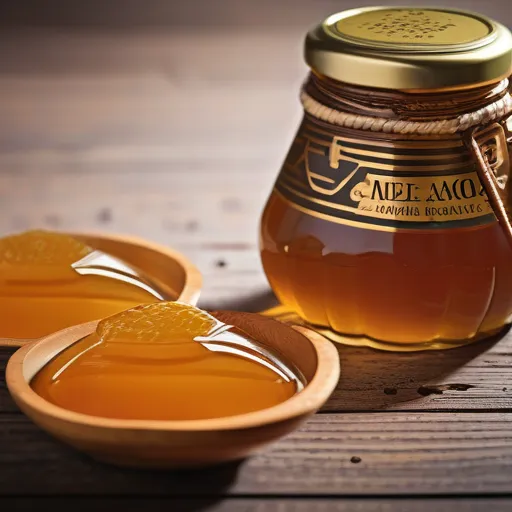
Pure Honey and Amlou: How to Recognize Artisanal Quality (and Avoid Scams)
At markets, fine food shops, or online, pure honey and artisanal amlou appeal with their “natural” image. Yet nectar adulteration, spreads disguised as amlou, and vague labels remain common. This guide gives you concrete habits for buying with confidence — without relying on taste or the golden color of the jar alone.
Quick answer: For honey, demand a single ingredient and an identifiable country of harvest. For amlou, only three components: culinary argan oil, roasted dried fruit, and honey. Beware of overly smooth textures, “vegetable oil” mentions with no specifics, and prices inconsistent with argan’s real rarity.
Key takeaways
- Honey: country of harvest mandatory in the EU; crystallization = often a positive sign.
- Amlou: argan + almonds or peanuts + honey — Moroccan origin and named producer.
- Common fraud: diluted syrup, ultra-filtration, “amlou-style” spreads without real argan.
- Buying habit: read the label before the price, never the reverse.
| Criterion | Authentic product | Warning sign |
|---|---|---|
| Honey | One ingredient: honey; beekeeper or region specified | Added glucose, opaque “EU/non-EU” blend |
| Amlou | Argan + dried fruit + honey, cooperative or identified artisan | Sugar first, flavorings, sunflower oil |
| Texture | Honey varies by bloom; amlou creamy, sometimes grainy | Permanently fluid, perfectly smooth like Nutella |
| Price | Reflects artisanal work and rare argan | Amlou jar priced like industrial jam |
Why does honey quality affect amlou?
In amlou, honey is not just a sweetener: it binds the dried fruit paste, softens the roasted notes, and influences shelf life. Adulterated or overly watery nectar unbalances the texture and masks argan oil’s aroma. Souss artisans choose thyme or mountain honey, fluid but concentrated. For the overall nutritional profile, see the benefits of Moroccan amlou.
Pure Honey: The Most Common Frauds
Interpol ranks honey among the world’s most counterfeited foods. Common practices: dilution with rice or corn syrup, opaque blending of international lots, ultra-filtration that removes trace pollen. In France, the DGCCRF reminds us that golden, fluid honey year-round is no proof of authenticity.
Misleading claims on jars
- “Honey from our regions” with no country of harvest: marketing claim, not an origin guarantee.
- “Creamy honey”: texture from pasteurization — not fraud, but can mask a blend.
- “Organic honey” with no AB or Ecocert number: verify on the certifier’s website.
- Mandatory cold storage: often a sign of excess moisture in the nectar.
Home Tests: Useful, Never Sufficient
The cold water or absorbent paper test circulates on social media. These methods can spot excess water or syrup, but also produce false positives depending on floral variety or degree of crystallization.
| Method | What it may indicate | Main limitation |
|---|---|---|
| Absorbent paper | Rapid absorption = moisture or syrup | Very fluid acacia honey: ambiguous result |
| Cold water | Rapid dissolution = likely syrup | Crystallized honey: atypical behavior |
| Label + seller | Origin, batch, traceability | Does not detect invisible adulteration |
| NMR analysis (lab) | Exact isotopic composition | Reserved for importers and official controls |
European Regulatory Framework
Since 2022, the European Union requires the country of harvest on every honey jar. From June 2026, blends must display the percentage of the four main origins. Until then, favor single-country or monofloral honeys, easier to trace than a generic blend.
Amlou: Spotting Counterfeits
The amlou boom in Europe has attracted “Moroccan-inspired” spreads: sunflower oil instead of argan, added sugar, emulsifiers for a Nutella-like texture. Here are the most frequent red flags:
- More than three ingredients or “vegetable oil” mention with no named argan.
- Perfectly smooth texture, stable for months at room temperature.
- Oriental packaging, but producer and region absent from the jar.
- Vague production date — artisanal amlou is best consumed within months.
- Derisory price given the real cost of culinary argan oil.
Our guide on where to buy authentic Moroccan amlou lists trusted channels for e-commerce and fine food shops.
Does the organic label protect against honey fraud?
Organic certification imposes controls on all three amlou components, which reduces adulteration risk. Still verify the certification number (AB, Ecocert…) on the jar. Organic guarantees no synthetic pesticides, not automatically exceptional-tasting honey.
Building a Coherent Honey + Amlou Basket
The best producers offer honey and amlou from the same terroir. The nectar chosen for amlou is selected for fluidity and aroma — not price per kilo. Beware of packs where only the amlou carries the “artisanal” label.
| Question to ask | Pure honey | Artisanal amlou |
|---|---|---|
| Producer | Named beekeeper or cooperative | Souss women’s cooperative or identified artisan |
| Origin | Precise region or country of harvest | Anti-Atlas, Souss-Massa, Essaouira… |
| Storage | Dry pantry, away from light | Airtight jar — see amlou storage |
| Point of sale | Market, beekeeper, fine food shop | Specialty store, transparent importer |
Frequently asked questions
- Crystallized honey = expired? No — it is often a sign of authentic honey. Gentle bain-marie (< 40 °C) to make it fluid without degrading enzymes.
- Barley glucose syrup in amlou? Contains gluten and never appears in the traditional recipe — read the ingredient list.
- Amlou vs Nutella? Different categories: three-ingredient Berber spread vs industrial sugary spread — see amlou vs El Mordjene.
- Trust taste alone? The palate quickly adapts to sugar. The label remains your best ally.
- Where to buy with confidence? Browse our Moroccan delicatessen.
Recognizing pure honey and authentic amlou means adopting a simple habit: short ingredient list, named origin, transparent seller. A few minutes reading before purchase protects your budget — and the work of Moroccan beekeepers and cooperatives.
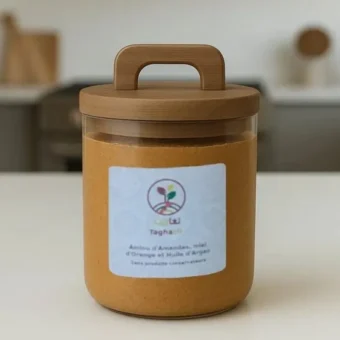
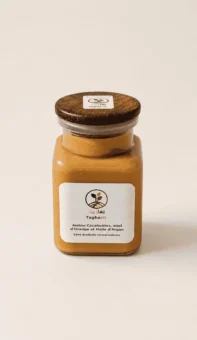
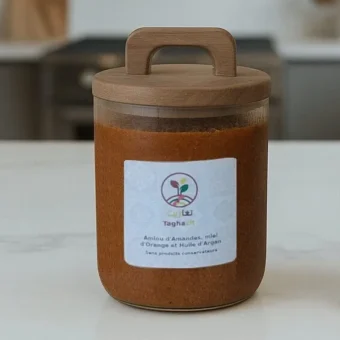
Our artisanal amlou: verifiable quality
Three ingredients, Moroccan origin, artisanal production — here are our amlou references that meet this article’s criteria.
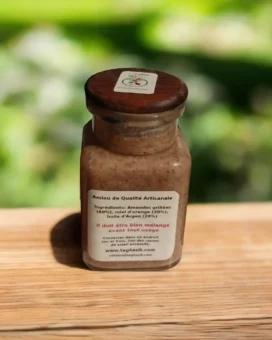
Discover our authentic Moroccan products
Explore our selection of delicatessen and Moroccan specialties: artisanal amlou, pure honey, and traceable argan oils.