
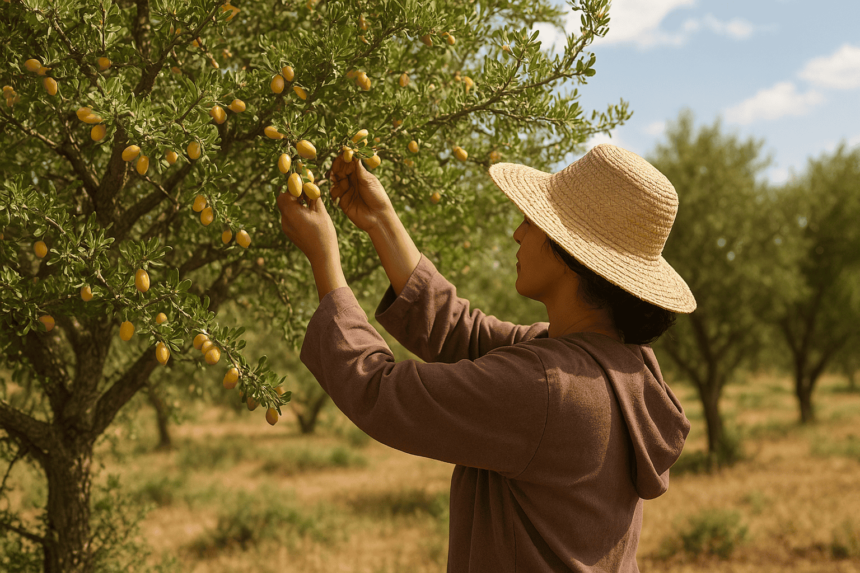
The Argan Journey: From Tree to Your Table
Between the argan groves of the Souss and your kitchen or bathroom, argan oil travels a long and meticulous path. Harvesting, drying, shelling, grinding, cold pressing: each step relies on Berber know-how passed from mother to daughter. Understanding this journey means appreciating the value of authentic oil and the work it represents.
Quick answer: Argan oil comes from kernels manually extracted from the fruit of the argan tree (Argania spinosa), endemic to southwestern Morocco. Low-temperature mechanical extraction yields virgin oil, without solvents or chemical refining.
Key takeaways
- Strict endemism: the argan tree grows naturally only in southwestern Morocco.
- UNESCO heritage: argan groves have been listed since 2014.
- Artisanal labor: nearly 20 hours of work for one liter of oil.
- Full valorization: shells, pulp, and kernels each find a use.
The Argan Tree, Sentinel of Southern Morocco
The southern Moroccan argan tree can live more than two centuries. Its deep roots anchor arid soils, retain moisture, and slow desert advance. Each tree produces between 30 and 50 kg of fruit per year, but only a fraction becomes oil: roughly 35 kg of fruit are needed for one liter. This rarity explains the price of pure and authentic argan oil.
The fruit resembles a green olive that turns yellow when ripe. Inside, a hard shell protects one to three kernels rich in essential fatty acids, vitamin E, and polyphenols. To explore their benefits, see our article on argan benefits for body, skin, and hair.
From Harvest to Bottle: Six Key Steps
| Step | Artisanal gesture | Quality stake |
|---|---|---|
| 1. Harvest | Manual collection of ripe fruit, on the ground or on the tree | Exclude moldy or damaged fruit |
| 2. Drying | Exposure to sun for several weeks | Reduce moisture, prepare shelling |
| 3. Shelling | Cracking the shell between two stones | Extract intact kernel, meticulous gesture |
| 4. Grinding | Kernels transformed into paste on a millstone | Slow grinding to avoid heating |
| 5. Cold pressing | Mechanical pressure < 40 °C | Full nutritional profile preserved |
| 6. Filtration | Natural decanting or light filtration | Clear oil, no chemical refining |
Culinary or cosmetic oil: where does the journey diverge?
The path is identical until grinding. The divergence occurs at roasting: kernels destined for culinary oil are lightly roasted, giving an amber color and a toasted hazelnut aroma. Cosmetic kernels are not roasted: the oil obtained is lighter, more neutral, ideal for skin and hair.
Women’s Cooperatives: Heart of the Supply Chain
Argan cooperatives in Morocco bring together hundreds of Berber women from Souss villages. This economic model ensures fair pay, transmission of know-how, and quality control at every stage. Cooperative members master the entire chain: from harvest to packaging.
Buying oil from these structures means funding preservation of the argan tree, empowerment of rural women, and maintenance of a UNESCO-listed ecosystem. At Taghazit, every bottle is selected from these partner cooperatives.
From the Press to Your Daily Use
After extraction, the oil rests for a few days for natural decanting, then is lightly filtered and packaged in dark glass — essential to protect vitamin E from light. Culinary oil flavors salads, pancakes, and couscous; the cosmetic version nourishes skin, hair, and beard, including in a men’s routine, as detailed in our article on men’s care with argan oil.
Amlou extends this gustatory journey: almonds, honey, and argan oil united in an emblematic spread. Discover how it is made in our guide to organic artisanal amlou, or its athletic use in the article on amlou for sport.
| Argan tree derivative | Material used | Main use |
|---|---|---|
| Culinary oil | Roasted kernels | Cooking, seasoning |
| Cosmetic oil | Non-roasted kernels | Skin, hair, nail care |
| Amlou | Argan oil + almonds + honey | Spread, snack |
| Shells and pulp | Shelling residues | Fuel, goat feed |
One Tree, One Territory, One Sustainable Model
The argan sector is not just a luxury product. It helps fight desertification, carbon sequestration, and creation of sustainable jobs in a region with limited economic opportunities. Every responsible purchase funds replanting argan trees and training new cooperative members.
Choosing traceable oil rather than a generic bottle with no identifiable origin means voting for a model that pays Berber women’s work and preserves living heritage.
Frequently asked questions
- How much fruit for one liter of oil? About 35 to 40 kg of fruit, or nearly 2 kg of kernels. Hence the rarity and price of argan oil.
- Goats in argan trees: myth or reality? Traditionally, goats eat the fruit and expel the nut, easing harvest. Controlled grazing preserves ecosystem balance.
- How to store oil after opening? Away from light and heat, between 15 and 20 °C. Consume within 12 to 24 months.
- Is there organic certification? Yes. Many cooperatives produce certified organic oil (Ecocert, AB), guaranteeing no synthetic pesticides.
The argan journey tells a story of territory, people, and an irreplaceable tree. By choosing traceable, artisanal oil, you become part of this preservation.
Discover our authentic Moroccan products
Browse our range of traditional oils: culinary and cosmetic argan, cold-pressed and from Moroccan cooperatives.