
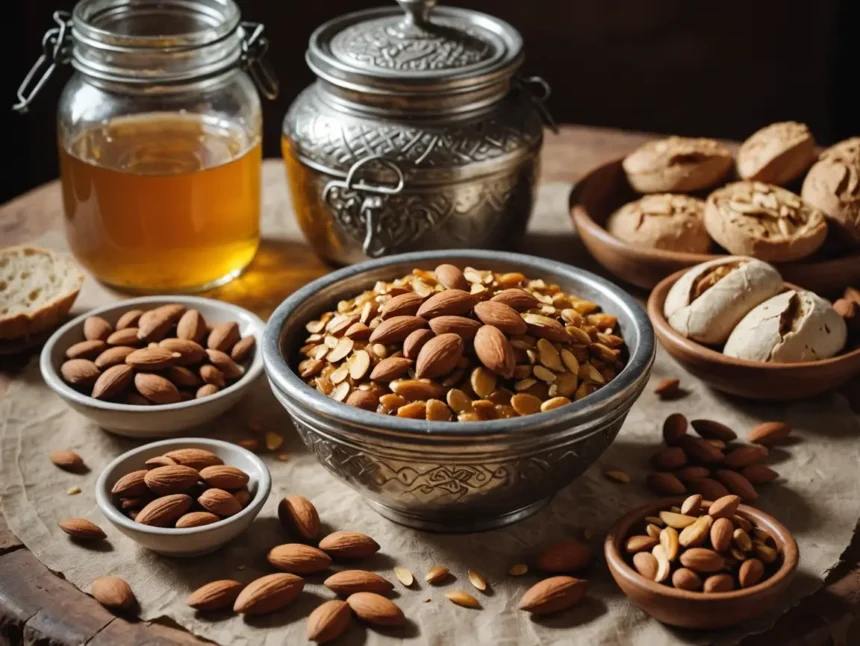
Moroccan Amlou: A Gourmet Treasure with a Thousand Benefits
On the foothills of the Anti-Atlas, between flowering almond trees and centuries-old argan trees, a creamy paste is born from millennia-old gestures: roast, grind, bind. Moroccan amlou condenses an entire Atlantic terroir identity into a single spoonful — argan oil, roasted nuts, and pure honey composing a sweet-savory symphony found nowhere in the industrial spreads aisle.
Quick answer: Moroccan amlou combines three noble ingredients — culinary argan oil, roasted nuts, and honey — for a creamy texture and unique flavor profile. Rich in unsaturated fatty acids, plant protein, and antioxidants, it outperforms industrial spreads, provided you choose an authentic artisanal version.
Key takeaways
- Origin: Souss-Massa plain, Anti-Atlas foothills, from Agadir to Essaouira.
- Recipe: roasted nuts (~80%), argan oil (~14%), honey (~6%) — indicative proportions.
- Usage: breakfast, afternoon snack, baking, energy bite.
- Asset: vitamin E, omega-6 and 9, magnesium — naturally gluten-free.
| Ingredient | Role in amlou | Signature on the palate |
|---|---|---|
| Almonds or peanuts | Protein and textural base | Roasted notes, melting crunch |
| Argan oil | Lipid binder, Moroccan emblem | Hazelnut aroma, creaminess |
| Pure honey | Natural sweetener, binder | Balanced sweetness, floral or thyme fragrance |
Where does the word “amlou” come from?
The Berber term amlou (or amlu) refers to this creamy paste throughout the argan-growing zone of southwestern Morocco. Once reserved for celebrations and the cool Atlas winters, it accompanied warm bread and mint tea. Exported to Europe today, it remains inseparable from the argan tree — an endemic species classified as UNESCO heritage.
A terroir between the Atlantic Ocean and the mountains
Amlou is born where almond trees and argan trees coexist: the Souss-Massa plain, Anti-Atlas foothills, around Essaouira and Taroudant. Each micro-region imprints its signature — bolder mountain honey, sweet Tafraout almonds, argan oil pressed the same day.
Traditional preparation involves hours of manual work: roasting nuts over a wood fire, grinding on a stone mill, slowly incorporating argan oil and honey until a homogeneous paste is obtained. No industrial process reproduces these roasted aromas and natural creaminess.
What amlou brings to your plate
Unlike commercial sweet spreads, Moroccan amlou concentrates complementary nutrients in a single spoonful.
Quality energy, lasting satiety
Calories come from three balanced sources: unsaturated fats from argan, protein and fiber from almonds, natural carbohydrates from honey. The result: satiety that lasts until lunch, without the glycemic spike of an industrial sweet spread.
Vitamins, minerals, and antioxidants
| Nutrient | Source in amlou | Dietary interest |
|---|---|---|
| Vitamin E | Argan oil | Antioxidant, skin support |
| Omega-6 and omega-9 | Argan oil, almonds | Unsaturated fatty acids |
| Magnesium | Roasted almonds | Nervous system, muscles |
| Phytosterols | Argan oil | Lipid balance |
| Fiber | Nuts | Digestion, satiety |
To explore each benefit in depth, see our article on the benefits of Moroccan amlou.
Five original ways to enjoy it
Amlou goes far beyond the morning toast. Here are uses that reveal its versatility:
- Berber breakfast: msemen or baghrir spread with amlou, mint tea on the side.
- Energy bowl: amlou + plain yogurt + fresh figs + cinnamon.
- Home baking: cookies or energy balls — amlou partially replaces butter and sugar.
- Comfort smoothie: banana, almond milk, amlou, ginger.
- Sweet-savory pairing: drizzle on roasted carrots or quinoa salad.
Spotting authentic Moroccan amlou
Growing popularity attracts imitations. Four markers to avoid mistakes:
- Three ingredients maximum, Moroccan origin indicated.
- Producer, cooperative, or region identifiable on the jar.
- Creamy texture, sometimes slightly grainy — no industrial smoothing.
- Price consistent with the genuine rarity of culinary argan oil.
Our guide on where to buy genuine Moroccan amlou completes this checklist for e-commerce and fine food stores.
Is Moroccan amlou gluten-free?
Yes — the traditional recipe contains no wheat, barley, or rye. Only industrial variants or cross-contamination in production facilities can introduce gluten. People with celiac disease should check the label or contact the producer.
Amlou vs supermarket spreads
Compared to Nutella, peanut butter, or Maghrebi spreads, Moroccan amlou stands out for its transparent composition and territorial roots. Our comparison which spread beats amlou and the article amlou vs El Mordjene detail the nutritional and flavor differences.
Storage: preserving freshness
Without artificial preservatives, amlou requires a few precautions: airtight jar, cool and dry place, clean spoon at each use. Pantry or fridge? The answer depends on your consumption rate — see Optimizing Your Amlou’s Preservation.
Frequently asked questions
- Almonds or peanuts? Same recipe, different nut: almonds are milder, peanuts are more intense and slightly salty.
- How many calories per spoonful? About 90 to 110 kcal for 15–20 g — an energy-dense product to enjoy in moderation.
- Is it suitable for children? Yes, in small amounts. Watch for tree nut allergies.
- Why more expensive than Nutella? Rare argan oil, manual production, small volumes.
- How to avoid scams? See our guide on pure honey and amlou: quality and scams.
Moroccan amlou condenses the history of a terroir, the warmth of a Berber breakfast, and the nutritional richness of the argan tree into a single spoonful. A gourmet treasure that deserves a place in every curious kitchen.
Discover our authentic Moroccan products
Explore our selection of fine food and Moroccan specialties: artisanal amlou, argan oils, and Moroccan delicacies.