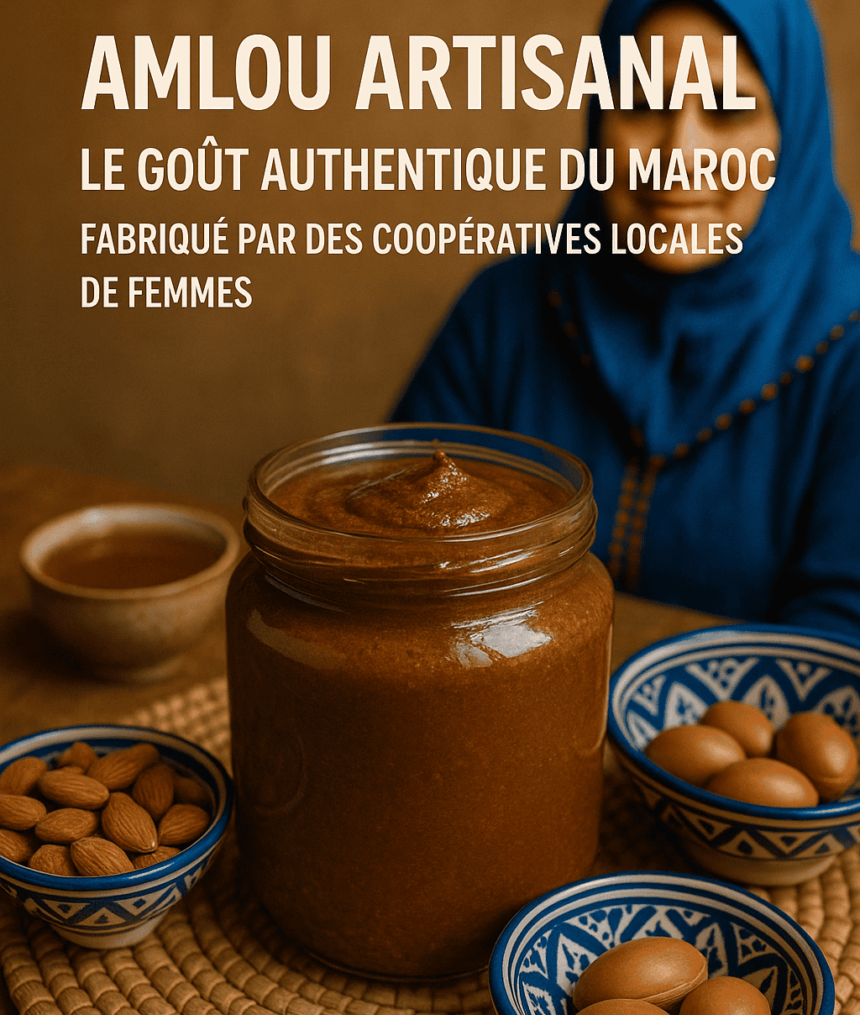
Artisanal Amlou: The Authentic Taste of Morocco, Crafted by Local Women’s Cooperatives
In Tafraout, Imi, or the douars around Essaouira, Berber women transform argan kernels into precious oil every morning, then into artisanal amlou. Far from a simple exported spread, this is matriarchal know-how — recognized by UNESCO — that converts food into direct income for rural families in southern Morocco.
Quick answer: Amlou from women’s cooperatives follows the traditional recipe (argan oil, roasted nuts, honey) while returning a fair share to the producers. Buying this jar means funding a local economic model and savoring a quality that industry cannot reproduce.
Key takeaways
- Cooperatives: groups of women around the argan tree, mainly in Souss-Massa.
- Techniques: manual shelling, cold pressing, roasting, stone grinding.
- Impact: income, literacy, preservation of the UNESCO-classified argan tree.
- Quality: small batches, traceability, three ingredients without additives.
| Step | Cooperative techniques | What you taste |
|---|---|---|
| Harvest | Picking argan fruits, sun-drying | Fresh oil, intact aromas |
| Shelling | Manual cracking of kernels between two stones | Intact kernels, zero solvents |
| Roasting | Slow grilling of almonds over controlled fire | Caramelized notes, controlled bitterness |
| Mixing | Gradual hand incorporation of oil + honey | Creamy texture, sweet-savory balance |
Why do women hold the argan supply chain?
Historically, argan oil and amlou production is matriarchal in southwestern Morocco. Berber women hold the know-how of shelling, roasting, and mixing. Since the 1990s, cooperatives have structured this expertise into a recognized activity: training, quality control, access to national and international markets.
From the argan tree to the spoon: a short supply chain
The argan tree (Argania spinosa) grows only on a coastal strip of Morocco, between Essaouira and Tiznit. Classified as UNESCO World Heritage in 1998, it is threatened by urbanization and overgrazing. Women’s cooperatives contribute to its preservation by valorizing every kernel — no waste, no race toward industrial standardization.
The journey of a typical cooperative amlou:
- Collection: fruits gathered, dried, hand-shelled to extract the kernel.
- Pressing: culinary oil obtained mechanically by cold pressing, without chemical solvents.
- Preparation: roasted almonds, ground, bound with local honey and fresh argan oil.
- Marketing: direct sales, export via ethical partners, agricultural fairs.
Social impact: much more than a spread
Buying cooperative amlou is a concrete act of fair trade — even without an official Fair Trade label on every jar.
| Dimension | For the producers | For the territory |
|---|---|---|
| Economy | Salary or share of cooperative profits | Retention of youth in rural areas |
| Training | Literacy, food hygiene, management | Collective skills development |
| Environment | Reforestation and protection of argan trees | Combating desertification |
| Culture | Transmission of Berber know-how | Living UNESCO-recognized heritage |
In Europe, demand for authentic amlou is growing. Beware of opaque intermediaries who resell a cooperative product without returning its fair share. Our guide on where to buy genuine Moroccan amlou details the trust criteria.
Taste quality: the advantage of small batches
Artisanal production in limited volumes allows adjustments impossible in a factory: honey dosage according to the harvest, more or less intense roasting, choice between almonds and peanuts depending on the season.
How to recognize authentic cooperative amlou
- Name of the cooperative or region on the label.
- Three readable ingredients — no endless list.
- Creamy, sometimes grainy texture, roasted aromas present.
- Recent production date and clear storage advice.
The organic version, when available, adds a guarantee on the absence of pesticides — a topic developed in our article on organic artisanal Moroccan amlou.
Supporting cooperatives from France
You do not need to travel to Morocco to make a difference. A few simple actions suffice:
- Buy from shops that name their producers and cooperatives.
- Avoid anonymous jars at rock-bottom prices on general marketplaces.
- Give cooperative amlou as a gift — each jar tells a human story.
- Share your discovery: ethical demand strengthens the entire supply chain.
Paris residents can consult where to find authentic amlou in Paris to locate reliable addresses.
Cooperative or individual artisan: what’s the difference for the buyer?
Cooperatives bring together several producers around common standards (hygiene, packaging, pricing). The individual artisan works alone or with family. Both can produce excellent amlou. What matters is traceability: who made this jar, with what ingredients, in which region.
Tasting and storage
Cooperative amlou is enjoyed on warm bread, msemen, baghrir, or by the spoonful with mint tea. Without preservatives, it keeps best in an airtight jar, in a cool place — see Optimizing your amlou’s preservation for indicative durations.
Frequently asked questions
- Do all cooperatives produce organic? No — some remain conventional but artisanal. Check the AB logo if organic is important to you.
- Is the high price justified? Yes: manual labor, low volumes, rare argan oil, and fair compensation for producers.
- Can you visit a cooperative? Several welcome visitors around Essaouira and Agadir — inquire before traveling.
- Almonds or peanuts? Almonds for sweetness, peanuts for intensity — both follow the traditional recipe.
- How to avoid counterfeits? See our advice on pure honey and amlou: quality and scams.
Artisanal amlou from women’s cooperatives is food with meaning: flavors of Morocco, rural employment, preservation of the argan tree. Every spoonful is a vote for a fairer food model — without giving up pleasure.
Discover our authentic Moroccan products
Explore our selection of fine food and Moroccan specialties: cooperative amlou, argan oils, and treasures of the Souss.